On the one hand, the possibilities for horror narratives seem endless. On the other hand, there are really only a dozen or so stories that get told and re-told in film form again and again. Haunted house, home invasion, vampires, zombies—just check the lengthy list of season categories over at the wonderful and in-depth Evolution of Horror podcast. And repetition isn’t bad when it’s done well. Give me good performances, good writing, and interesting cinematography and I’ll go to bat for any haunted house movie or The Real Monster Is the Repressed Family Secrets movie.
The problem with a lot of Japanese horror films of the last twenty years, though, is that they 1) repeat the same stories and character types ad nauseam and 2) aren’t interestingly directed. So I’m happy to report that Never After Dark, the first film to be produced by production company Signal 181, nails the writing, directing, and performances to offer a tight and occasionally terrifying take on the haunted house/exorcism story. Like the recent Exit 8, this is a film that, for once, does not appear to have been created by a production committee. The story framework is familiar, but the characters and the places they take us are new.
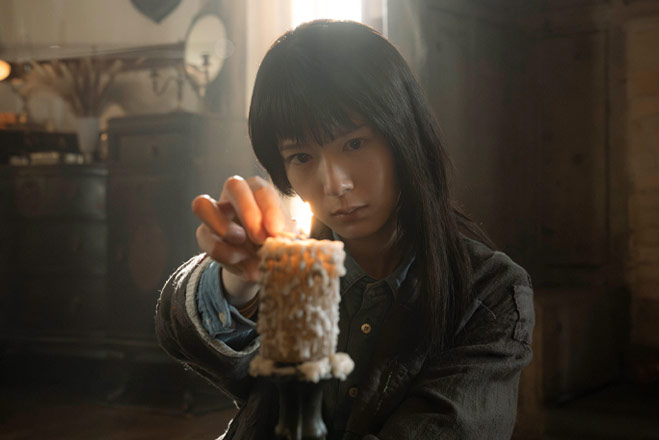
The premise is simple: professional ghostbuster Airi (Moeka Hoshi of Shogun) has been summoned to a remote country manor. The owner, Teiko (Tae Kimura), has had dreams and visions of a man wandering the halls of the building, and wants Airi to figure out what the spirit wants (and get rid of it). Her son Gunji (Kento Kaku, who also produced the film), is skeptical. Airi takes a generous deposit and tells mother and son that they must leave the premises while she tries to communicate with the spirit, as it’s dangerous for them to be there while she works.
And that’s really about as much as I should say about the plot to avoid the delightful surprises that pop up throughout the film. Suffice it to say that the ghost Airi finds herself dealing with is not at all friendly. Things take a pretty intense turn toward physical violence and gore in the third act, which may prove divisive. Director David Boyle said during a post-screening q & a that he wanted to avoid telling this story in the same way that so many horror films before had told it, and that he wanted to mix different genre elements. Which is valid, but it could be a turn-off for those who don’t like to mix violence and gore with their supernatural horror.
The film is carried on the very capable shoulders of Moeka Hoshi, who displayed a similar mix of vulnerability and steely resolve in Shogun. Here she is occasionally irritated, world-weary, amused, terrified, angry, and compassionate, conveying all of those emotions with subtle facial expressions (a good chunk of the film focuses on Hoshi’s face, so it’s good that she’s up to the challenge). Mutsuo Yoshioka, meanwhile, seems to have become the go-to actor for creepy weirdo characters—between Never After Dark, Chime, and Cloud, his not-quite-right affect never fails to send a chill down my spine. He’s at his most effective when he’s giving you an eerie half-smile and making small talk that somehow gives you the sense that something very bad is about to happen.
I’m also happy to report that Never After Dark is genuinely scary in several places (something that I haven’t found to be true of a lot of horror movies of the last several years, even ones I’ve enjoyed). I could have used a little more explanation as to the very unusual nature of this haunting, but I also appreciated that the film didn’t over-explain. Sometimes an eerie vibe and a hint of past wrongs is more effective than a detailed flashback.
More than anything, I’m happy to see that a film by a new production company founded by creative and passionate people is seeing a lot of early success at film festivals. Director David Boyle and producer Kento Kaku created Signal 181 based on the fact that they enjoyed working together (they had previously collaborated on Netflix’s House of Ninjas) and wanted to make interesting films without major studio interference. Though they will likely have to look toward international collaborations for future financing, Never After Dark announces them as a strong creative force in the Japanese film world, and reminds us that familiar stories can still be a fun ride when they’re written and directed in innovative ways.
Never After Dark opens in Japan on June 5.

