I have learned to temper my hopes for any new J-horror releases in the last fifteen years, simply because I’ve been disappointed so many times. I’ve given props to less-than-stellar films for at least having some interesting character and writing choices (Home Sweet Home, 2023) or an unexpected ending (Kisaragi Station, 2022). While there have been occasional outliers (Bilocation [2013], The Inerasable [2015], Creepy [2016], several films by Kōji Shiraishi), when it comes to mainstream J-horror, more often than not what we get is a poorly crafted collection of tropes—cursed objects, found footage, paper-thin characters—that don’t add up to anything entertaining, much less spooky.
So when I saw the title and basic premise of Ryota Kondo’s Missing Child Videotape (boy goes missing, VHS tape, spooky mountain), I was ready for another two hours of eye-rolling and sighing.
But I was pleasantly surprised to discover that this one was good.
Again, the bar is underground at this point. But about fifteen minutes into the film (at a packed screening at the Tokyo International Film Festival, where word had clearly gotten around), I realized that I was…engaged. Leaning forward in my seat. And getting chills pretty frequently.
Admittedly, MCV doesn’t really break new ground in the J-horror genre (and it could really use a better title, Missing Child Videotape feels like a placeholder). But it does what it does so well. It borrows from other films, but in a fresh and interesting way. It leaves us with plenty of questions, but not in the “that made no goddamn sense” manner of so many other J-horror films. Its characters and its world feel lived in. And it maintains a delightful level of ambiguity and unsolved-ness that’s refreshing after so many films that desperately try to explain their confusing plots with endless character monologues and dialogue.
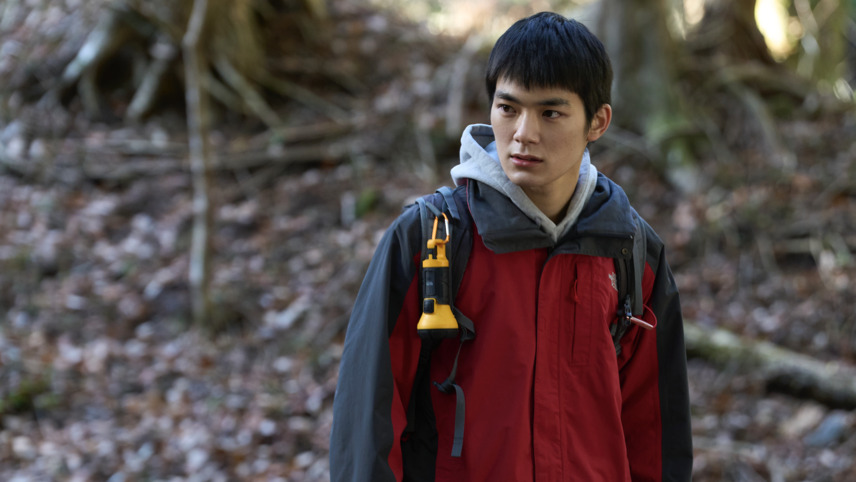
We begin in the year 2015 (not sure why that particular year was chosen, but I’ll go with it). Keita Kodama (Rairu Sugita, doing really good work here) is a sad-eyed twenty-something whose younger brother Hinata went missing thirteen years earlier under mysterious circumstances. One day, Keita receives a package in the mail—one of many packages of his father’s belongings that Keita’s mother has been sending him in the years since his parents divorced. In this package, though, in addition to the usual clothes and accessories, there’s a VHS cassette. On the tape is a record of the day that Hinata went missing, which, amazingly, was filmed by Keita, who had run off into the nearby woods with his father’s 2002-era video camera. Keita’s roommate Amon (Amon Hirai, who, conveniently, can see ghosts and has occasional tingles when supernatural things are afoot) is unnerved by the video and tells Keita that he should burn it.
The rest of the story unfolds like a combination ghost story and murder/missing person mystery, touching on the way that Hinata’s disappearance essentially destroyed Keita’s relationship with his parents, the strange history of the wooded area where Hinata disappeared, a journalist (Kokoro Morita, very good) who gets caught up in the story, and Keita’s still-desperate desire to find out what happened to his brother.
What struck me most about the film was just how solid so many of the details were—the performances, the writing, the camera work, the sound design. Our two lead actors actually feel like real people with real histories (though as usual one of them, Amon Hirai, looks just a bit too model-esque to pass for an average cram school teacher). The use of music is minimal and effective—occasional hums and discordant notes instead of shrieking violins. A small number of sounds that repeat throughout the film create a real sense of unease. There are a very small number of jump scares—really closer to “flinch scares.” Instead, the film just creates a very palpable sense of eeriness, with a few slow pans of the camera that have you dreading what you’re eventually going to see. And while we always have a fairly clear sense of what’s going on and what our various characters’ motivations are, a lot of the film’s big questions remain unanswered, or at least open to interpretation.
The use of older forms of media and media objects is also really, really effective. The footage on the VHS cassette is extremely grainy and unclear—just enough to make us wonder what we’re seeing, but also to make us relieved that we’re not seeing it with total clarity. An audio cassette introduced later offers further tantalizing hints about what happened to Hinata. In a time when so much J-horror tends to be filmed with extremely bright lighting and colors (perhaps the better to showcase the young models/tarento/pop stars who frequently appear in the films), it was refreshing to see old-school fuzzy images used to great effect. MCV borrows heavily from J-horror past—strange video tape, grainy footage, side character who sees ghosts, bad things happening to children, hints of an ancient evil in a rural area—but it takes those familiar ideas in such interesting new directions. And it really sticks the landing.
Remarkably, this is writer-director-editor Ryota Kondo’s first feature (he had worked previously as an assistant director on Ju-on: House of Curse). And it looks like he’s only in his mid-thirties. He’s got plenty of time to make more films, which I will definitely watch.
 eiga files